Worked model · EX302
Scissor lift: the lowest position can be the hardest
Three stacked scissor stages raise a loaded platform. A horizontal actuator changes the base width, converting its travel into vertical platform movement.
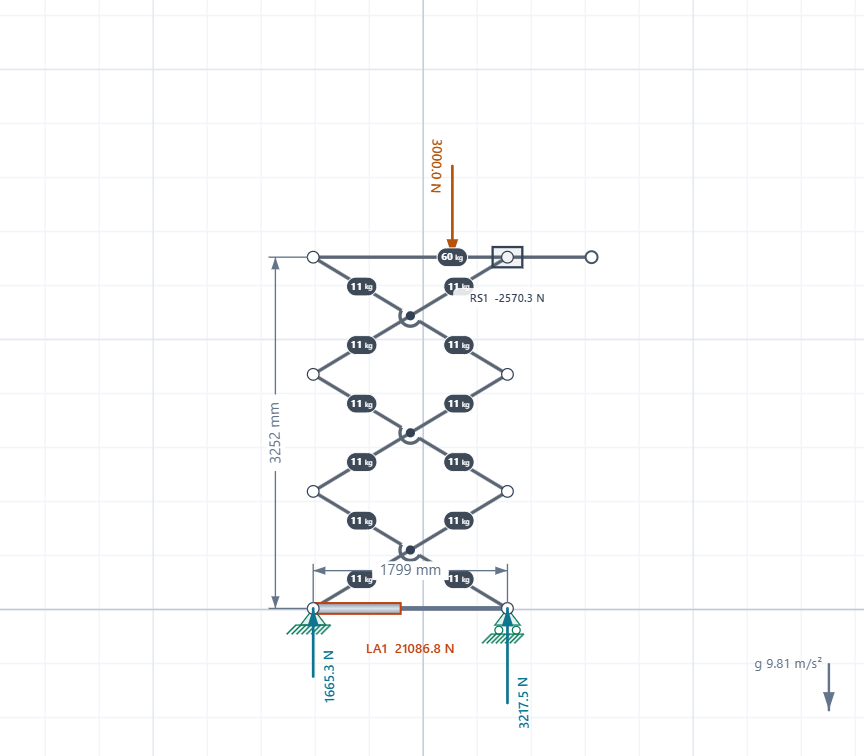
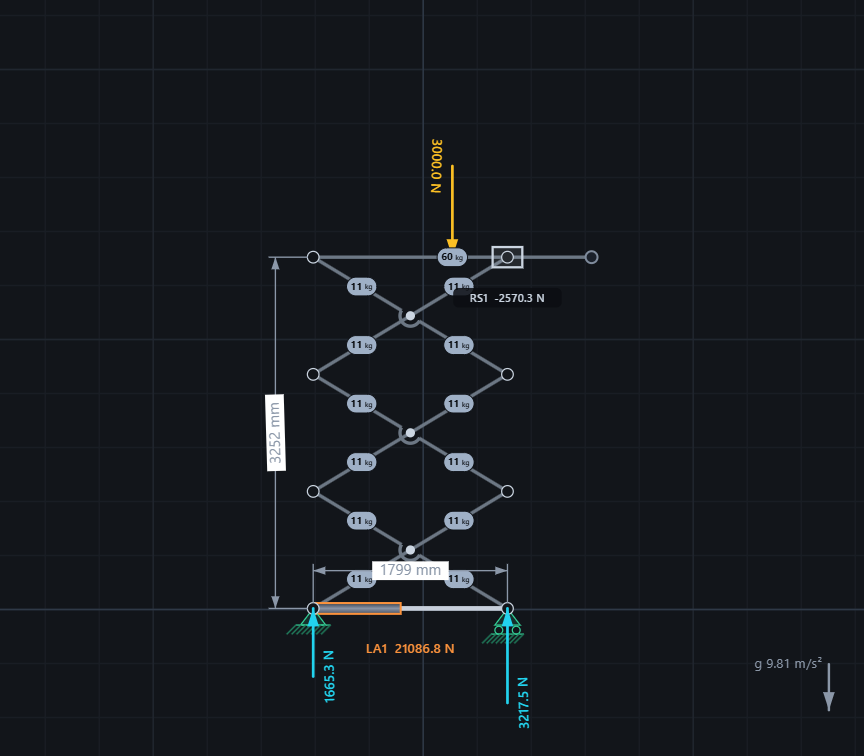
Three-stage scissor lift
Play or scrub the historical report to compare platform position and actuator force.
View solved report preview app interfaceInputs in the worked model
A 3,000 N downward load acts at the midpoint of the platform beam. Twelve scissor half-members each have mass 11 kg; the platform member has mass 60 kg. The model's total member mass is 192 kg. Gravity is enabled at 9.80665 m/s² and inertia is disabled.
The platform travels from 1.65 m to 4.35 m. The picture shows it 3.252 m up, with the base 1.799 m wide.
Check the total vertical load
The twelve half-members and the platform weigh 192 × 9.80665 = 1,882.877 N. Added to the platform load, the external downward force is 4,882.877 N, and the two ground reactions together balance it. The horizontal actuator force is not part of this sum.
Ay + By = 3000 + 192 × 9.80665 = 4,882.877 N
| Quantity | Result | Direction |
|---|---|---|
| Platform load | 3,000 N | Downward |
| Member weight | 1,882.877 N | Downward |
| Left reaction Ay | 1,665.3 N | Upward |
| Right reaction By | 3,217.5 N | Upward |
In the app, at this position the actuator carries 21,086.8 N, and the two reactions, 1,665.3 N and 3,217.5 N, add up to the 4,882.877 N above.
Relate actuator travel to platform movement
For an ideal compatible motion, actuator work balances the change in gravitational potential energy. A small change in base width can produce a larger change in platform height when the scissors are low. That geometry can produce a large actuator demand.
Each member's centre of mass moves differently, so applying the platform load alone to one generic scissor formula would omit part of this model. Use the full geometry and all configured masses when making a virtual-work comparison.
Use the report as a worked illustration
The report loads only when you choose to open it. It contains recorded drawing frames and results, rather than an editable public solver. Friction, transient acceleration, stability, structural capacity and cylinder selection require additional analysis beyond the hand check here.
Keep exploring