Guide · mechanism forces
Why actuator force changes with position
An actuator has to balance the moment of the load it moves. As the mechanism moves, the actuator's lever arm changes — so one force value rarely covers the whole stroke. Depending on the geometry, the force can climb or fall.
Balance the forces at one position
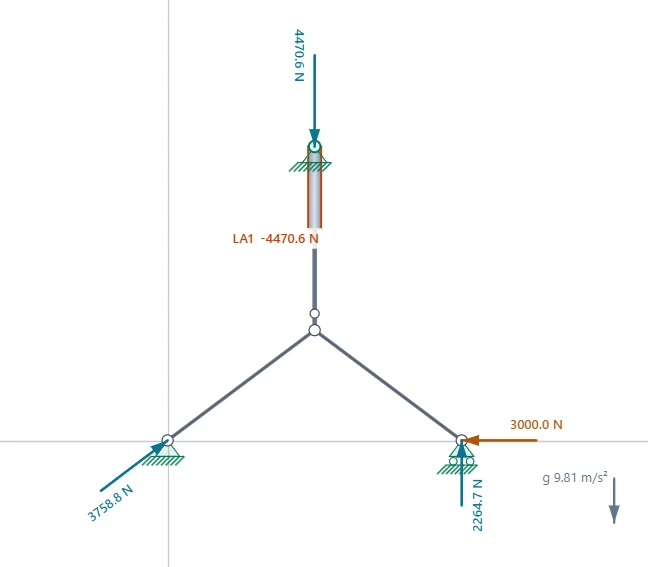
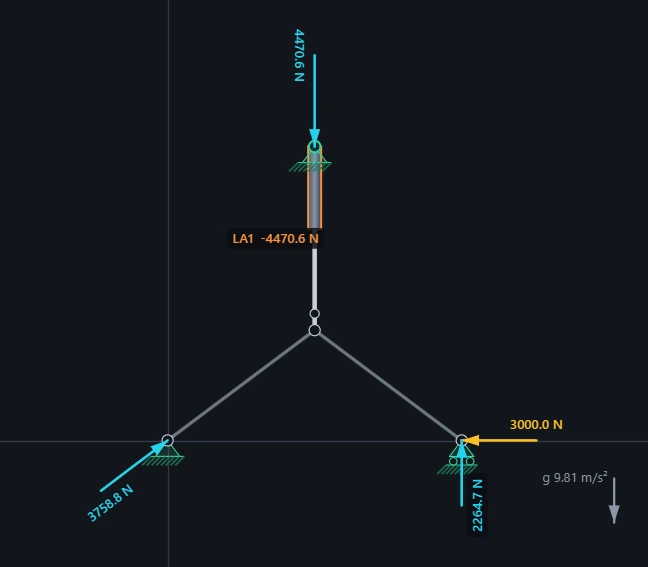
Take the toggle clamp in the picture: two 0.75 m links meet at a knee 0.45 m above their supports, which stand 1.2 m apart. A vertical actuator presses on the knee, and a 3000 N load pushes the roller C to the left. First leave out the links' weight.
Each link makes an angle α with the horizontal. The roller is in balance when the link's horizontal force equals the load; the knee is in balance when the two links' vertical forces equal the actuator's.
tan α = 0.45 / 0.6 → α = 36.9°; F cos α = 3000 → F = 3750 N; Fact = 2F sin α = 2 × 3750 × 0.6 = 4500 N
| Quantity | Result | Direction |
|---|---|---|
| Link force F | 3750 N | Compression |
| Actuator, links weightless | 4500 N | Down on the knee |
| Actuator, with the links' weight | 4470.6 N | Down on the knee |
| Reaction at A | 3000 N and 2264.7 N | Right and upward |
| Reaction at C | 2264.7 N | Upward |
The links weigh 3 kg each, and half of each link's weight rests on the knee, so the actuator needs that much less: 4500 − 2 × 14.7 = 4470.6 N.
In the app, the actuator force is 4470.6 N at this position. As the links straighten, α shrinks and so does 2 × 3000 × tan α: the same load needs less and less actuator force.
Knee-joint toggle (Kniehebel)
For an actuator attached at radius r, the perpendicular moment arm is r sin θ, where θ is the angle between the radius and the actuator's force direction. The attachment distance r alone is not enough.
As the force line approaches the pivot, its moment arm approaches zero. Balancing a nonzero load moment then demands a rapidly increasing force. The real arrangement may reach a geometric limit before the ideal expression becomes singular.
Follow the full mechanism
With more links, the hand calculation grows quickly: every body needs its own balance. In Free Body Diagram studio, the whole mechanism is solved at every position. Run the motion and watch the actuator force fall as the links straighten.
The calculation above is a teaching example, not an actuator specification. Friction, efficiency and component ratings need their own checks; inertia can be switched on in the app.
Keep exploring
Follow the next question
 Example · scissor lift
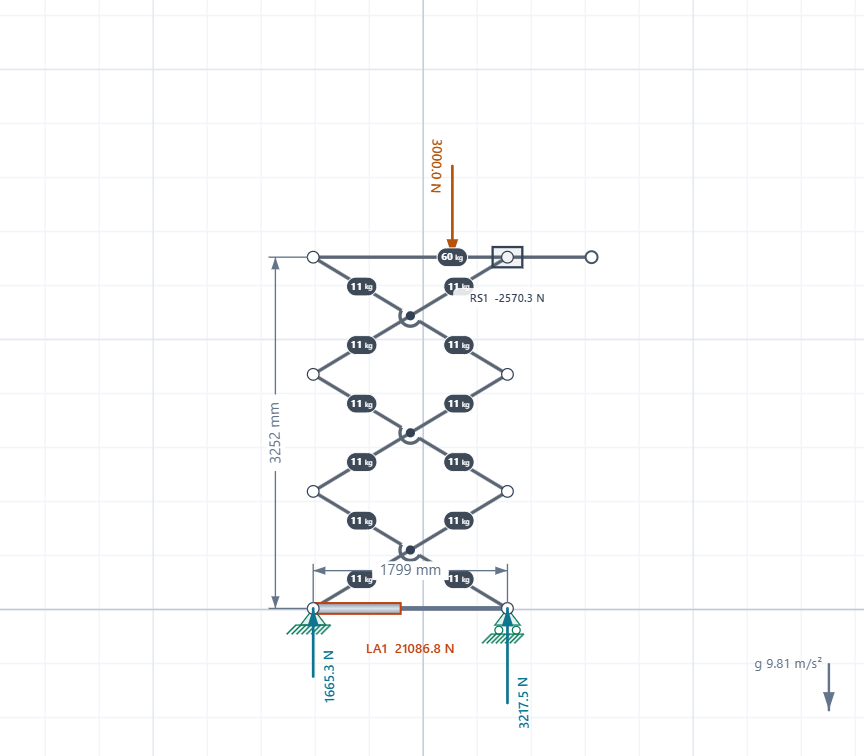
Scissor lift: the hardest pull is at the bottom
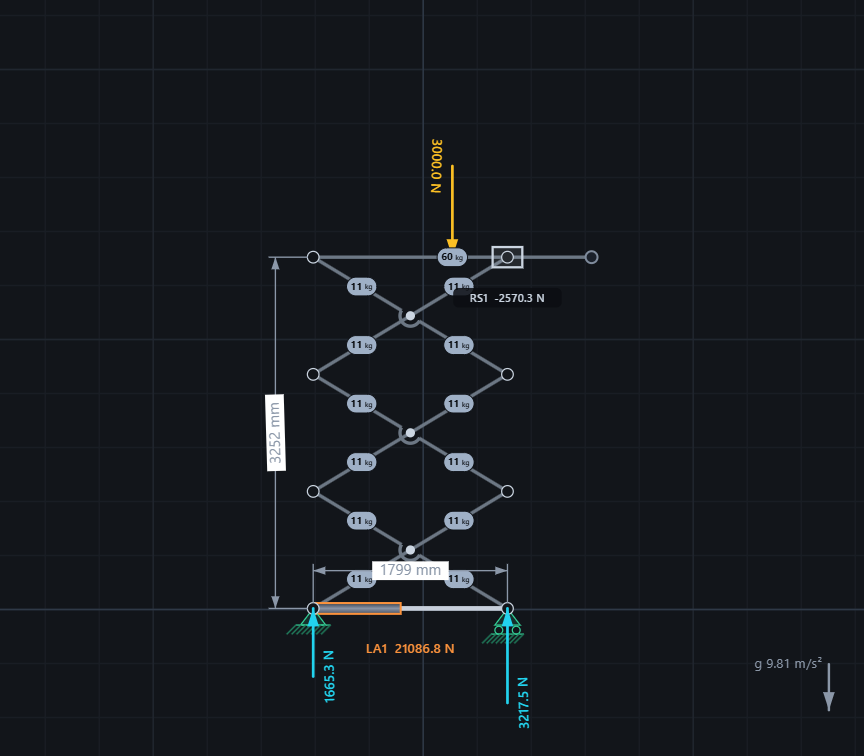
A three-stage scissor lift raises a 3 kN platform load. Watch the actuator force peak at the bottom and fall on the graph as the platform rises.
 Illustrated example · EX205
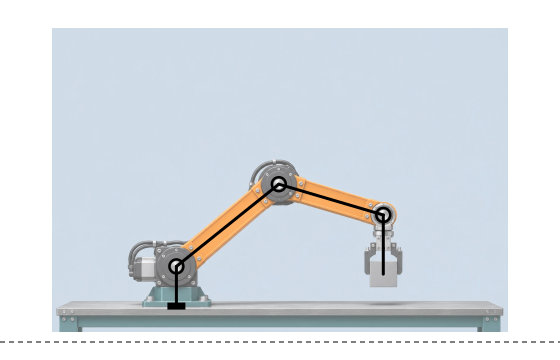
Robot arm — pick and place
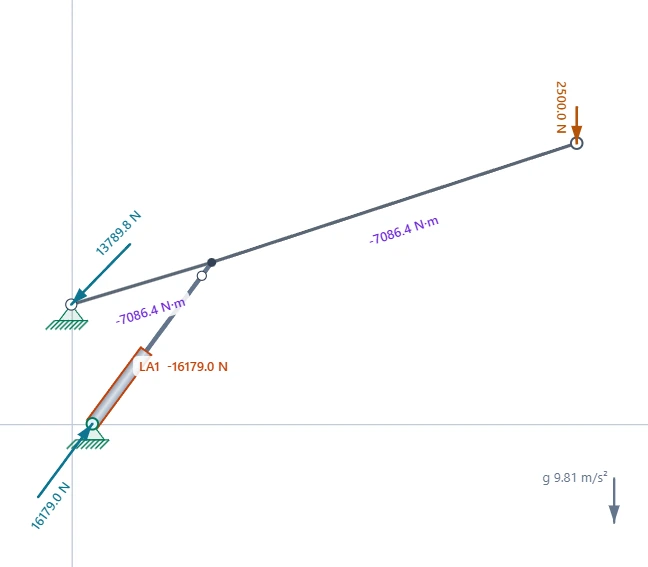
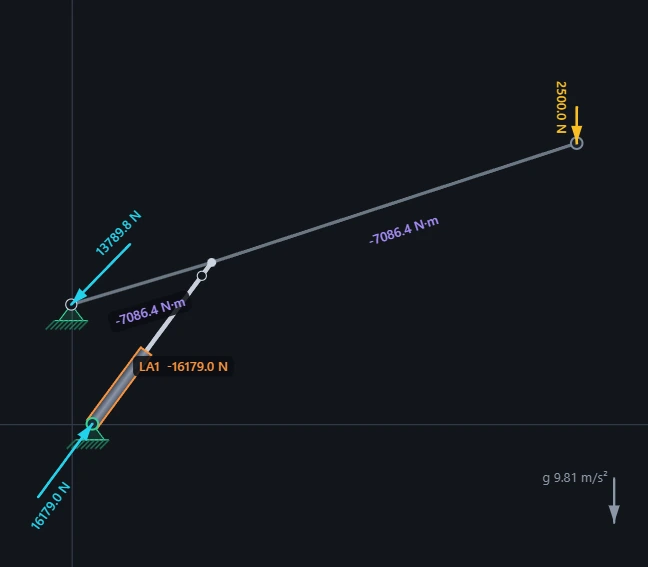
A 20 kg workpiece and an 8 kg gripper; follow the joint torques.
 For engineers and designers
Find worst positions and peak loads
Draw the mechanism and follow the support reactions and actuator loads through its whole motion. Understand the internal forces before you spend time in CAD or FEM.