Illustrated worked model · EX205
Robot arm — pick and place
A 20 kg workpiece and an 8 kg gripper; follow the joint torques.
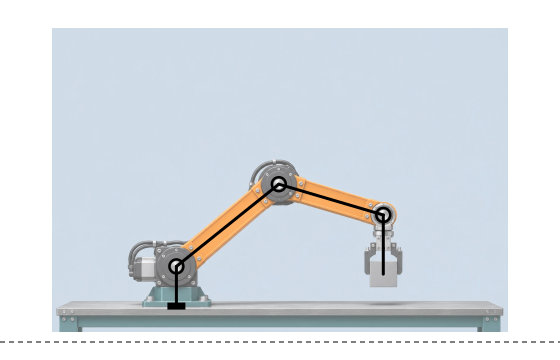
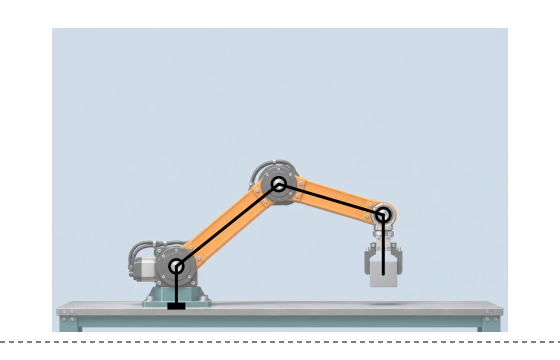
Robot arm — pick and place
Play, pause or scrub the recorded motion and follow the actuator force or torque curves.
View solved report No account required · starts paused · calculated resultsInputs and pictured load case
Upper arm 1,100 mm long and 35 kg; forearm 20 kg; gripper 8 kg; held workpiece 20 kg. Two moving joints coordinate the lift, and an idealised wrist constraint holds the gripper upright.
The dimensions and masses are plausible teaching estimates, not manufacturer specifications. Structural mass is distributed along the corresponding members, while payload masses act at their illustrated centres of gravity. Stationary foundations and chassis are excluded.
Check the weight
Gravity is enabled at 9.80665 m/s² and inertia is disabled. Count each payload once as mass; do not add a second downward force for the same object. The vertical reactions, including any grounded guide reaction, balance the total weight.
W = 83 × 9.80665 = 813.95 N
Check the initial joint torques
Take moments of every downstream weight about the joint. In the illustrated starting pose, the upper arm has horizontal reach 0.8577 m and the forearm 0.8751 m. Their uniformly distributed weights act at the link midpoints; the gripper and workpiece act on the vertical line through the wrist.
Melbow = 9.80665 × (20 × 0.8751 / 2 + 28 × 0.8751) = 326.1 N·m; Mshoulder = 9.80665 × (35 × 0.8577 / 2 + 20 × (0.8577 + 0.8751 / 2) + 28 × (0.8577 + 0.8751)) = 877.1 N·m
The viewer reads approximately 877.1 N·m at the shoulder and −326.1 N·m at the elbow. The elbow sign follows the actuator's convention. The vertical support reaction is approximately 814.0 N.
Read the animation
The illustration is a fixed reference aligned with the initial pose; the mechanism diagram moves over it. Play starts the motion, Pause holds it, and the time slider lets you inspect any recorded position. The force and torque plots share the drawing's time cursor. Use Drawing zoom to enlarge the labels and scroll the diagram; choose Fit whole drawing to restore the complete view.
These are recorded solutions of the same example document offered in the app. The public viewer does not recalculate new loads. Quasi-static results exclude acceleration, friction, structural strength and component ratings.
Keep exploring
Follow the next question
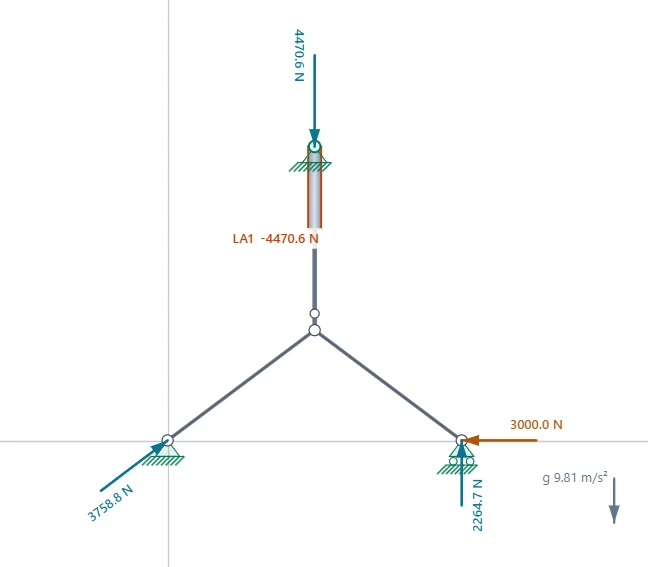
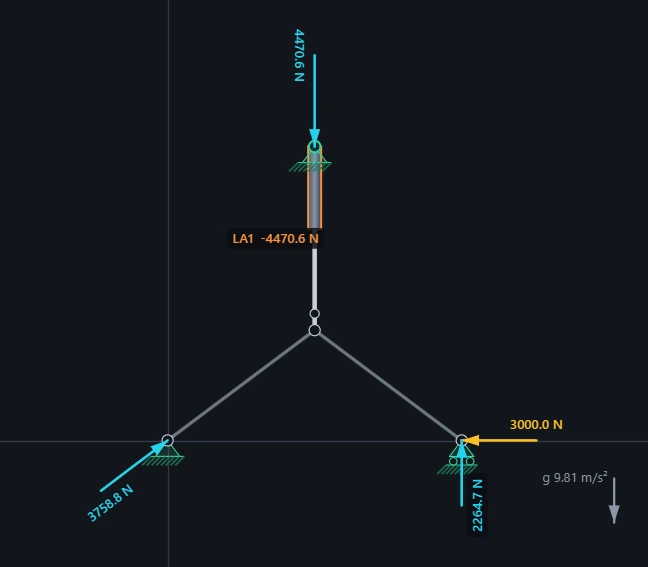 Guide · mechanism forces
Where does the actuator work hardest
The load stays the same, but the actuator force doesn't. As the lever arm shrinks, the force climbs.
 Guides and examples
From a single beam to a full structure
Step-by-step statics guides, with the free-body diagram showing the support reactions, then worked examples that build up to larger structures.