Guide · beam on two supports
Support reactions and internal forces
A beam on a pin and a roller, with a load over part of its length. Work out what each support carries, then see how the shear and bending moment change along the beam.
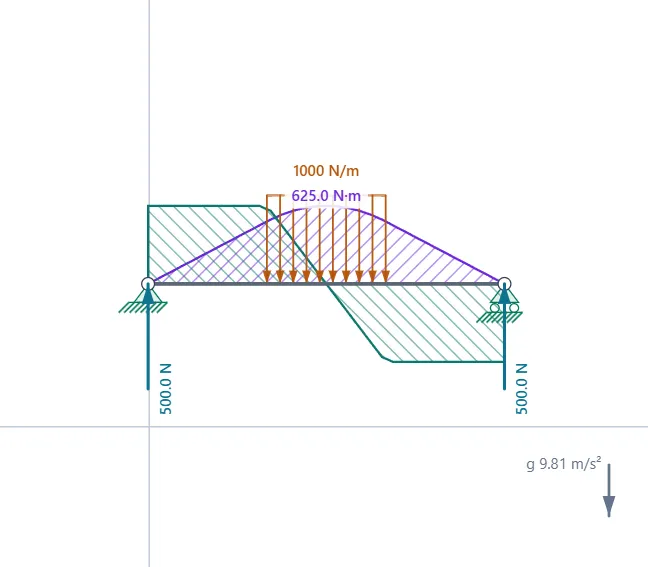
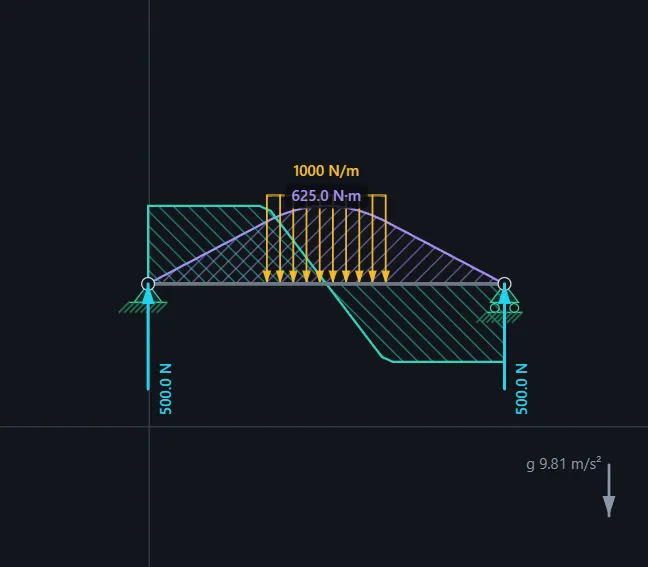
Build it in four steps
- Draw a member 3 m long, with no member mass.
- Add a pin support at the left end and a roller at the right end.
- Add a line load of 1000 N/m, pointing down, from 1 m to 2 m.
- See the results — both reactions, and the shear and bending moment along the beam.
More unknowns than independent equilibrium equations may require additional physical information; an unstable arrangement cannot be rescued by treating every reaction as an independent adjustable number.
Analytical hand calculation for comparison
The line load's resultant is 1000 N at mid-span. Take upward forces and counterclockwise moments as positive.
ΣMA: 3By − 1000 × 1.5 = 0; ΣFy: Ay + By − 1000 = 0; ΣFx: Ax = 0 Mmax = 500 × 1.5 − 1000 × 0.5 × 0.25 = 625 N·m
| Quantity | Result | Direction |
|---|---|---|
| Ax | 0 N | — |
| Ay | 500 N | Upward |
| By | 500 N | Upward |
| Moment at mid-span | 625 N·m | Sagging |
In the app, the shear is 500 N up to the load, falls through zero at mid-span and reaches −500 N where the load ends; the bending moment peaks at 625 N·m in the middle — the same values.
Interpreting the results
The closer support carries more. Move the load towards B and By increases while Ay decreases — try it in the app. A negative reaction means the force points the other way; check that the real support can provide it.
This example has no beam mass. Try adding self-weight and see how it changes results.
Keep exploring
Follow the next question
 Guide · cantilever beam
Every beam has to start somewhere
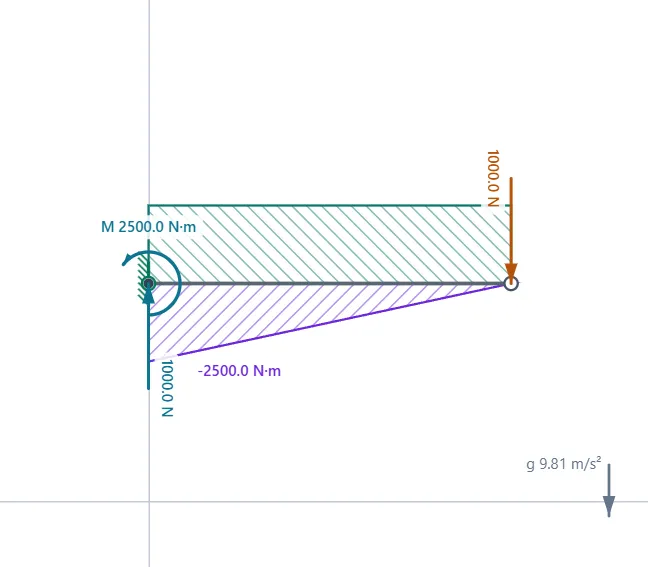
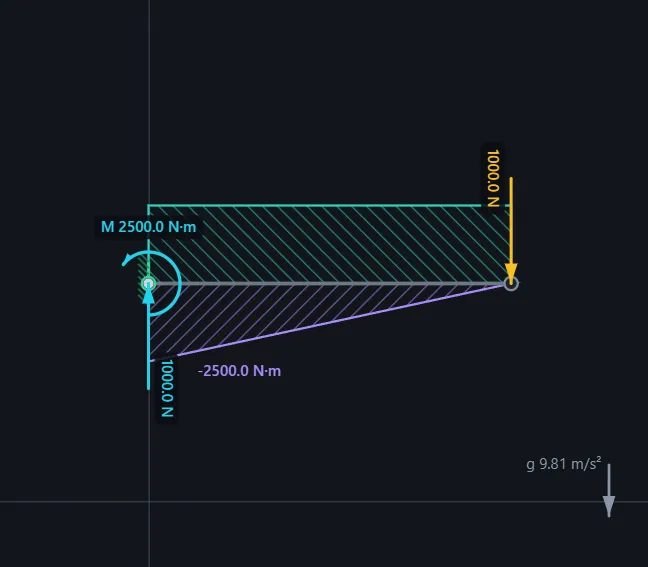
Start with the classic: a cantilever beam, fixed at one end, with a load on the other. See the reaction force and moment at the fixed end.
 Example · truss bridge
Truss bridge: trace the loads to the supports
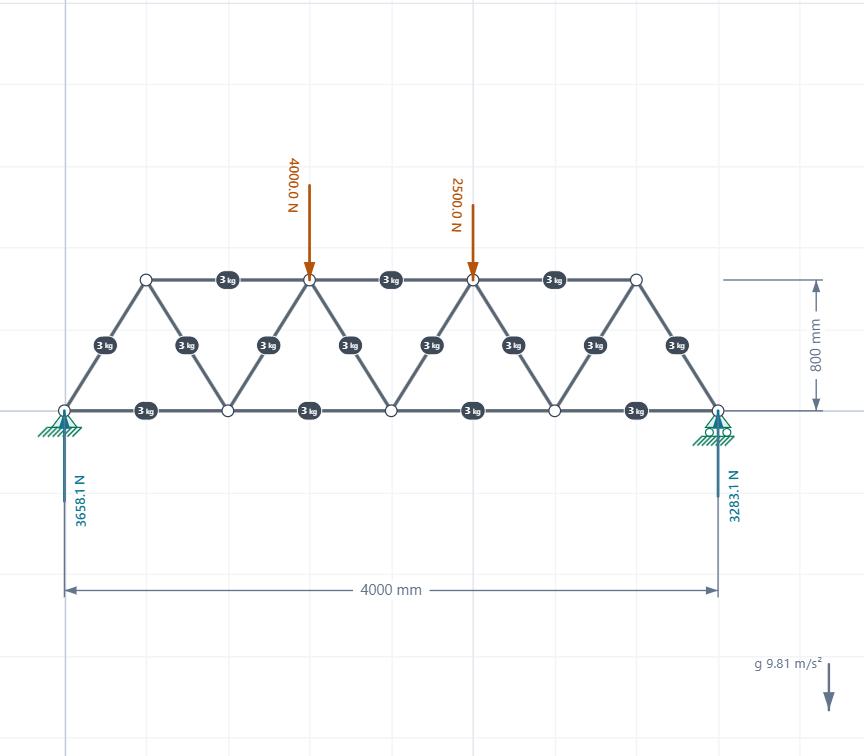
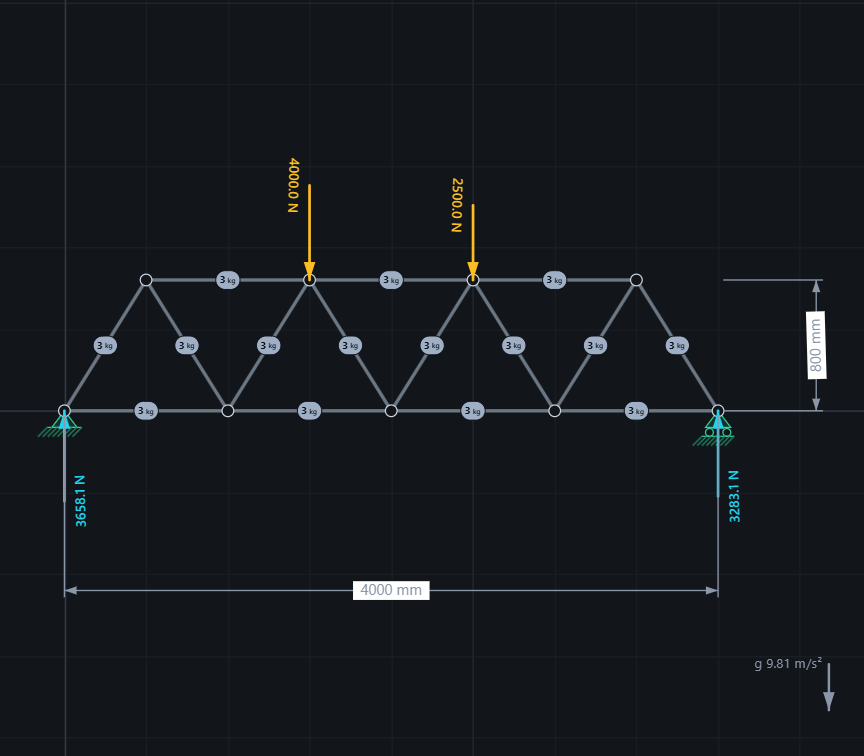
A truss bridge under two point loads and its own weight. See the tension and compression in every member, and what each support carries.